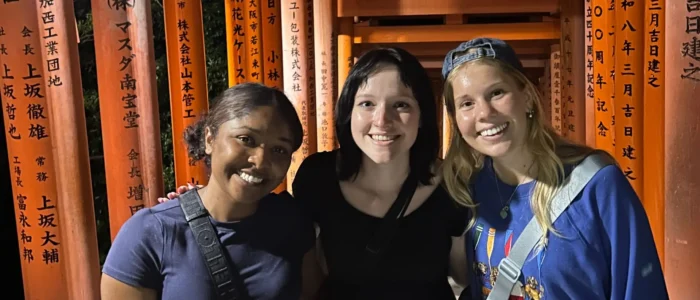
Exploring together: Students take an evening hike at the iconic Fushimi Inari shrine.
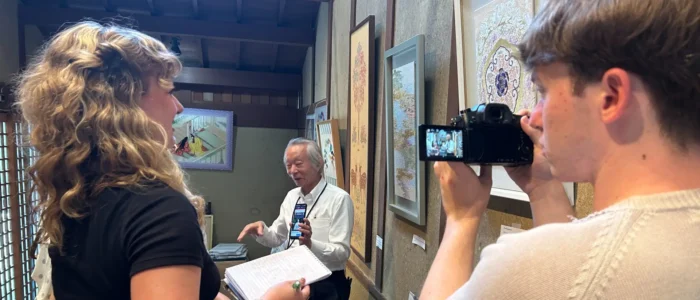
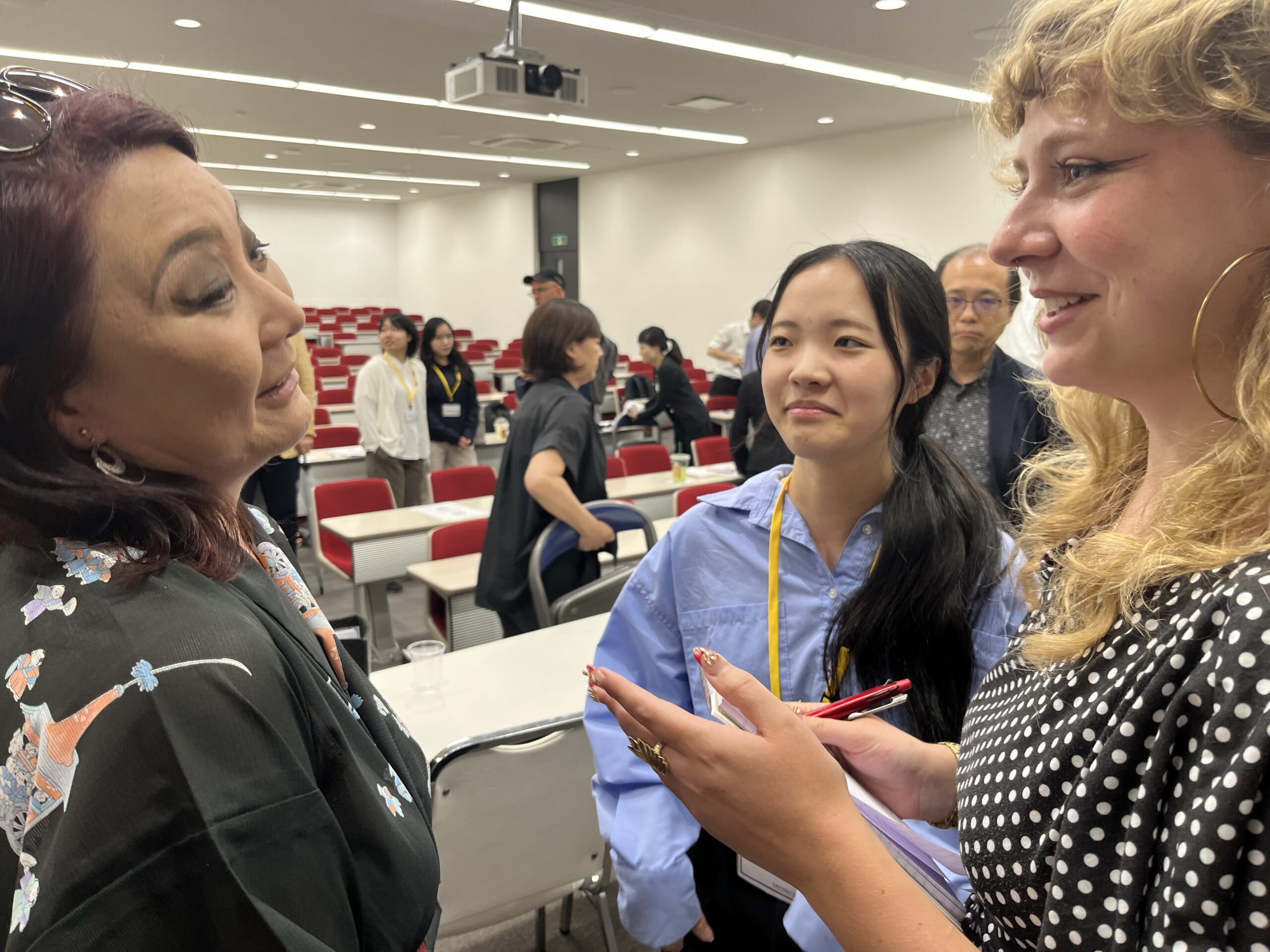
Out in the field: Students interview a source about efforts to preserve traditional crafts.
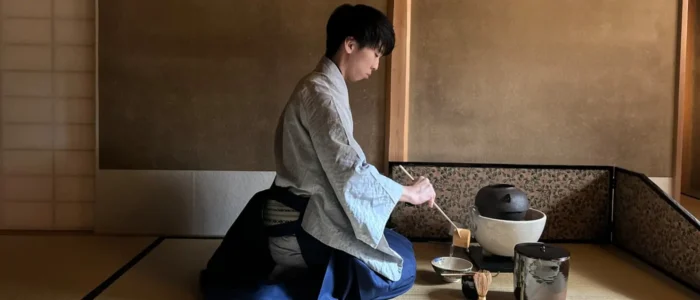
Preserving tradition: A tea master demonstrates the art of the traditional tea ceremony.

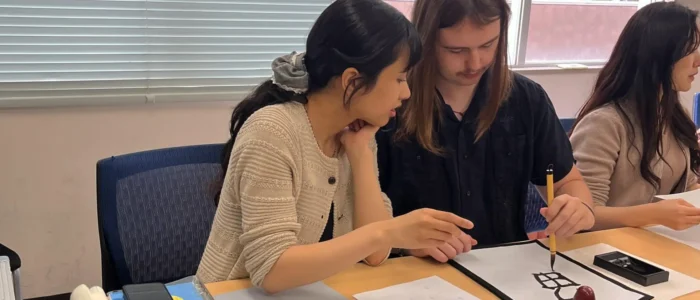
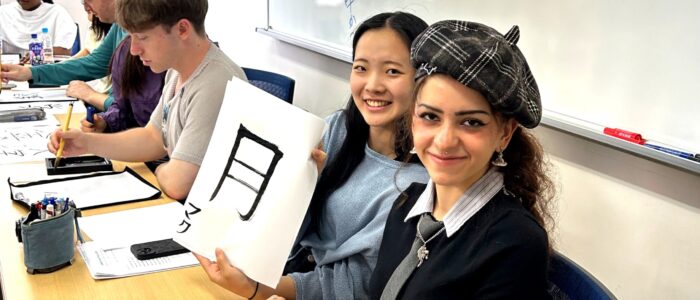
Mastering the brush: A Japanese student guides an American in the art of calligraphy.
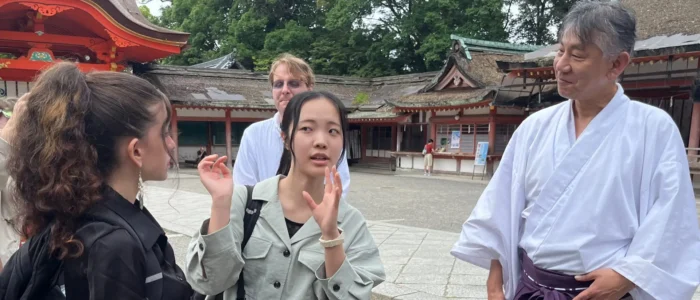
Bridging the gap: A Japanese interpreter helps American students interview a Shinto priest.
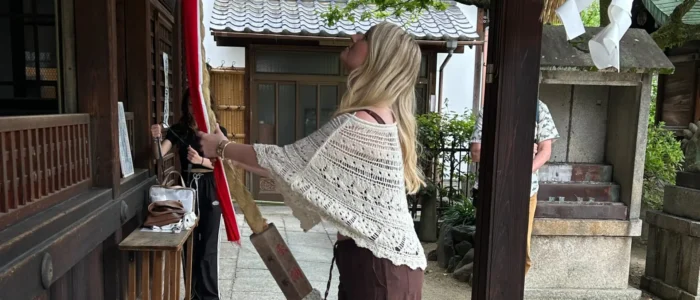
Experiencing Kyoto traditions: A student rings a bell during a visit to a shrine.
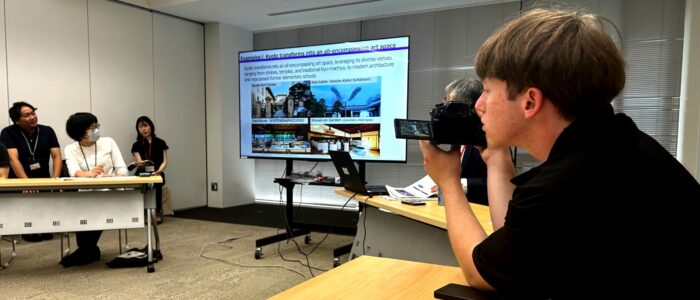
Real-world experience: Students cover a press briefing at Kyoto City Hall.
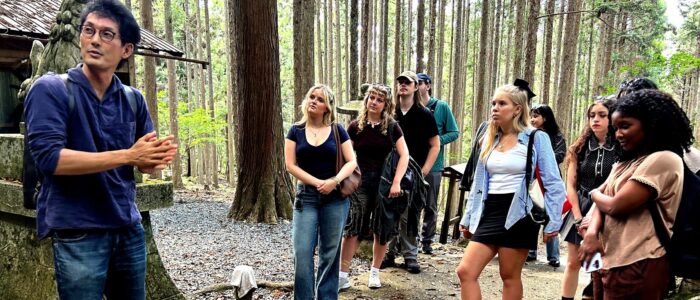
Exploring rural Kyoto: A local guide takes students to a shrine outside the city.
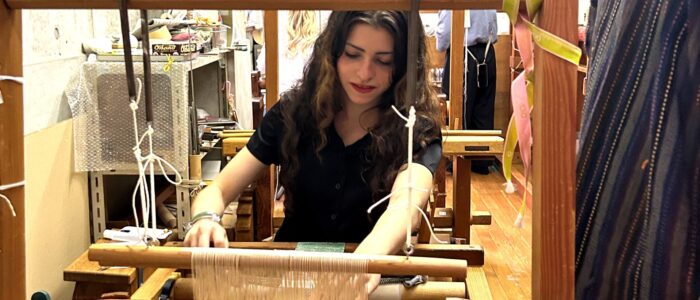
Learning by doing: A student tries her hand at a traditional loom.
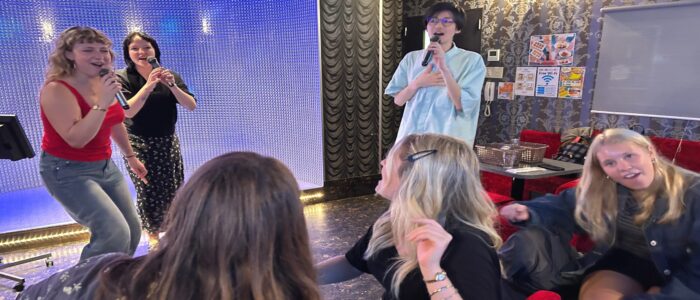
Taking the mic: Students unwind with an evening of karaoke.
Learning across cultures: Japanese and American students connect at a calligraphy lesson.
THE KYOTO PROJECT — 2027
FAST FACTS
DATES: May 25-June 25, 2027
LOCATION: Kyoto, Japan
ENROLLMENT CAPACITY: 14
FOCUS: International reporting, cross-cultural interviewing with interpreters, narrative writing, photography and multimedia storytelling
PROJECT COST: $6,395 + airfare
INCLUDES: Shared room accommodations in a hotel; welcome and farewell dinners, cultural events and travel insurance. Cost does not include airfare.
ACADEMIC CREDIT: Optional 3 transferable upper-division credits through the University of Jamestown ($450 additional)
THE PROGRAM
Spend a month in Japan learning how to find and tell stories across cultures.
Working alongside Japanese student interpreters from Kyoto University of Foreign Studies, you’ll venture into Kyoto’s neighborhoods, meet local residents and community leaders, and report on the people, places and issues shaping life in Japan today.
You won’t just study international journalism — you’ll practice it. You’ll learn how to research and develop compelling stories, conduct interviews across a language barrier, and use writing, photography and multimedia to bring those stories to life. Your work will be published in The Kyoto Project, our online magazine, giving you professional-quality work to add to your portfolio.
Along the way, you’ll be mentored by experienced journalists and professors who will help you develop your ideas and strengthen your storytelling. Whatever your major, you’ll come away with new skills, published work and the confidence that comes from reporting in another culture.
THE CITY
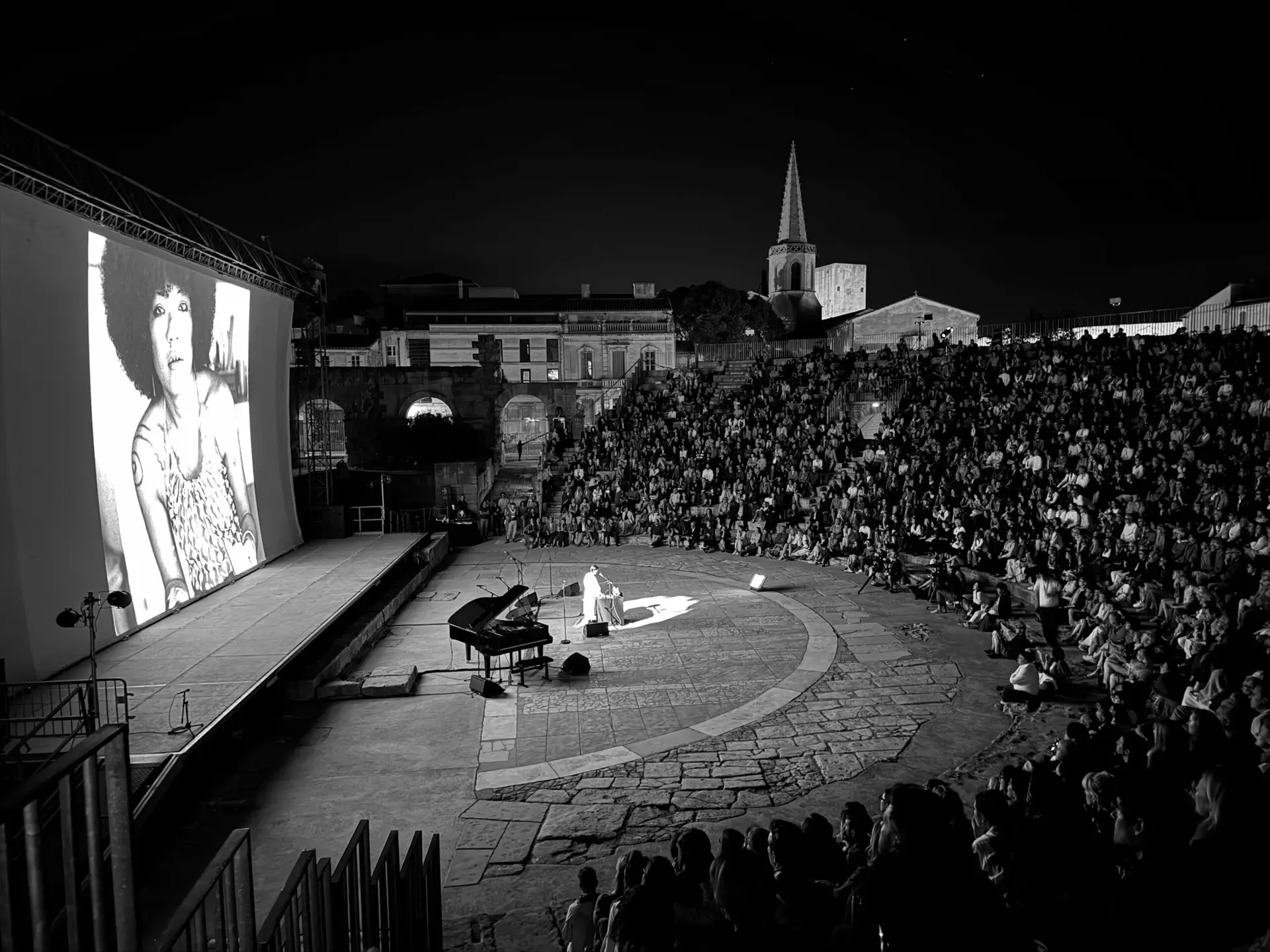
Home to an UNESCO World Heritage multi-site, Arles has been a longtime haven for archaeologists, ecologists, photographers and artists. At the apex of the delta formed by the Rhône River and the Mediterranean Sea, this coastal city became a strategically important provincial capital of ancient Rome, and several impressive ancient Roman monuments remain, including an arena that still hosts concerts and bull fights.
The city’s proximity to the Camargue marshlands — with its cowboys, rice fields and flamingos (!) — has made it a premier location for the study of Mediterranean wetlands and for exploring the unexpected.
Arles and its quaint microcosm of French life and culture also have attracted some of Europe’s most famous artists, including Paul Gaugin, Pablo Picasso and Vincent Van Gogh, who produced an astounding collection of more than 300 paintings and drawings of the city and its environs during the 15 months he lived there. The Fondation Vincent Van Gogh Arles contemporary art museum, which is dedicated to his legacy and the artists he inspired, has a permanent place in his beloved French home.
A PHOTOGRAPHY HUB
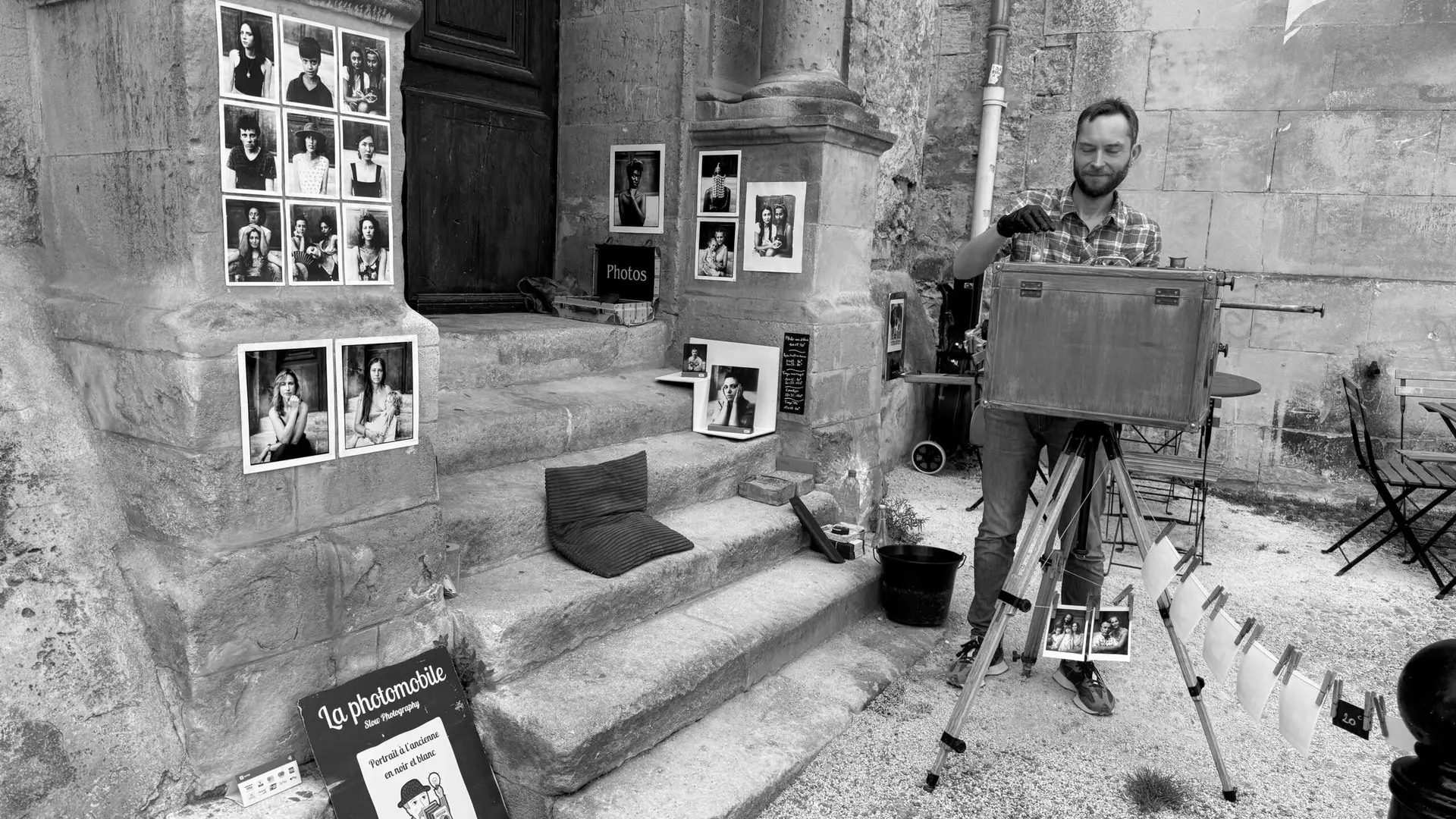
Arles is also a major center for photography, home to École nationale supérieure de la photographie, the country’s only higher education institution focused purely on photographic arts and image-making; ; Musée Réattu, Arles’ fine arts museum that pioneered public institutional support for photography in the 1960s and includes works by masters like Man Ray and Ansel Adams; the VII Foundation’s Alexandra Boulat campus; and the world’s oldest international photo festival, Recontres d’Arles, which draws photographers, editors and gallerists from all over the world every July. We’ve timed our workshop to capitalize on this remarkable festival, and you’ll have passes to many of its opening week events.
A MUSIC HUB
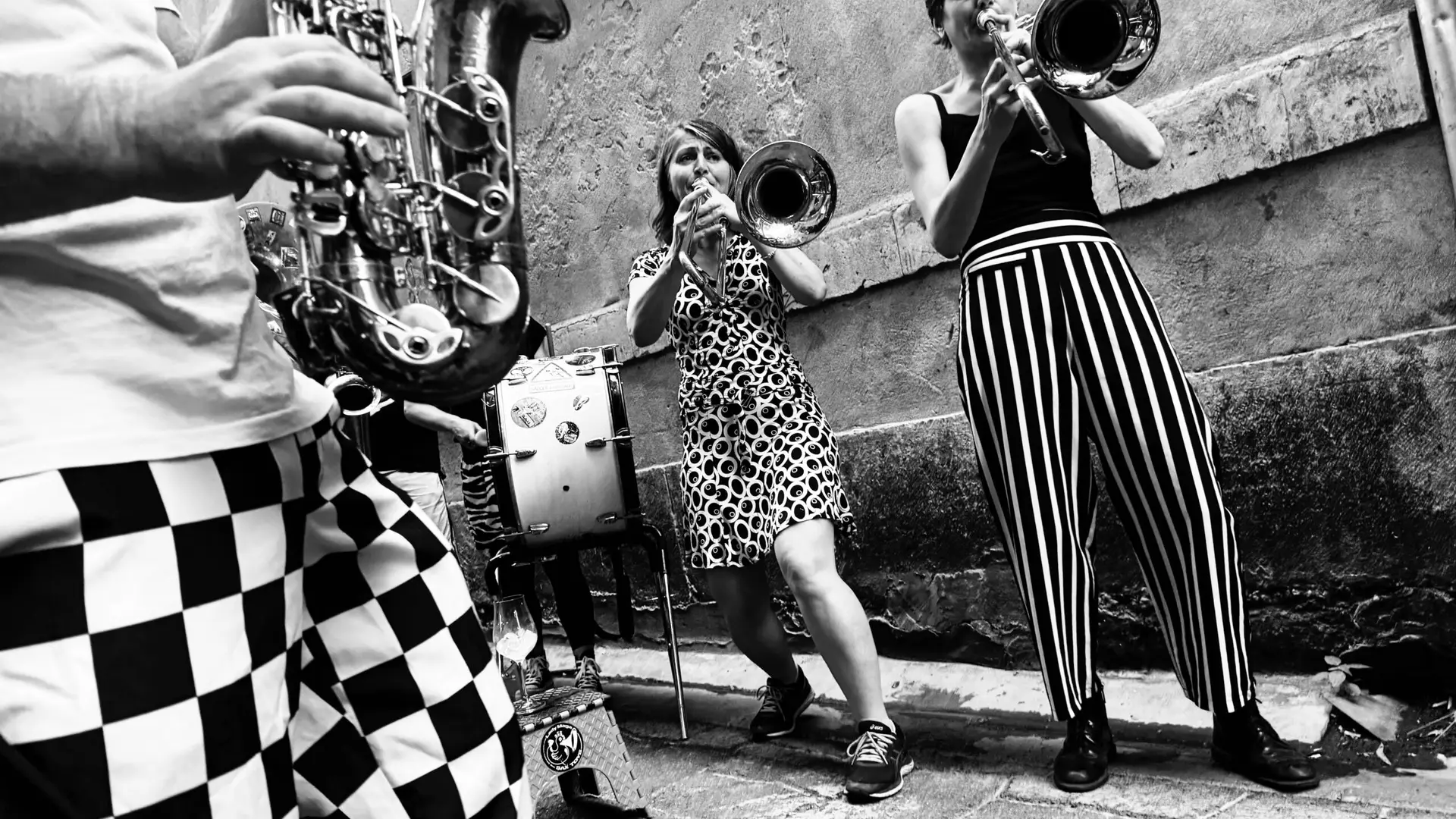
We will also be in town for Les Suds à Arles, a weeklong world music festival that focuses on global fusion, folk, traditional acoustic and regional rhythms and that takes over the city’s historical buildings, squares and streets.
THE PROGRAM
During this immersive four-week experience, you will create a body of work under the guidance of mentors with extensive international work experience and learn how to …
- produce creative, compelling images that communicate a concept, theme or story
- work, live and maneuver in a foreign culture
- develop a project, including research and proposal writing
- edit for different platforms, including publications, exhibitions and social media
- learn to write compelling text to accompany your images
- fund future projects, especially through grants
- speak some basic French
- work with an interpreter
CULTURAL ACTIVITIES
The program includes a few group outings to some of the many cultural activities in and around Arles. Previous workshops have included the following:
- The Arles Saturday Market, one of the largest open-air markets in France and a treasure trove of story ideas, where you can meet farmers, fishermen, cheesemakers, artisans and many others from across the region.
- Some of the best-preserved Roman ruins outside of Rome (without the crowds), including a classical theater, an arena, a necropolis and remains of Roman baths, some of which date back to the first century B.C.
- LUMA Arles, with its distinctive Frank Gehry-designed tower and gardens, an experimental cultural arts center that blends cutting-edge art, environmental science, and architecture to spark cultural and economic revival and offers artists new perspectives for creation, collaboration and public presentation.
- A Van Gogh walking tour that retraces the artist’s steps through the gardens, streets and monuments that inspired him.
- The Carrières des Lumières, just a half-hour away, a massive former limestone quarry transformed into a breathtaking digital art museum with awe-inspiring immersive exhibitions in a unique setting.
HOUSING
Students will stay with host families in Arles, who will provide the following:
- A single or double bedroom (depending on the host’s home)
- A shared or individual bathroom (also depending)
- Daily breakfasts and four dinners per week
- Sheets, towels and laundry facilities
Host families are carefully selected and regularly visited by our French partner, Arles à la Carte, to ensure student safety and comfort. Their host network comprises different family types: young families with children, couples without children, empty nesters, etc. Students are asked to provide detailed information about housing preferences when signing up for the workshop. Arles à la Carte then carefully matches students with host families, taking into consideration any allergies, health or diet requirements and specific living requests.
All host families live in the center of Arles within a 20- to 25-minute walk of our workshop headquarters, and everything in town is easily accessible on foot, from the historical monuments to the main shopping streets. Make sure to pack your favorite walking shoes!
OPTIONAL ACADEMIC CREDIT
Students on a semester system have the option to earn up to three academic credits of an upper-division elective for this course, issued by the University of Jamestown. Transfer credit acceptance, however, ultimately depends on your home university. Please check with your university for procedures to follow when transferring credits to your institution. The cost for three academic credits is $450.
Students on a quarter system will have the option to earn up to four academic credits of an upper-division elective for this course, issued by the University of Jamestown. Transfer credit acceptance, however, ultimately depends on your home university. Please check with your university for procedures to follow when transferring credits to your institution. The cost for four academic credits is $450.
EQUIPMENT
The workshop does not provide gear. Students must bring their own laptop computer, portable hard drive, mobile phone and digital camera equipment as well as any audio or video recorders if desired. Beginners without photographic gear are welcome to use their mobile phone camera. (A large part of learning how to make great images is learning how to see, and we will help you do that.)
LANGUAGE INSTRUCTION AND INTERPRETERS
All language instruction and interpreters also will be provided by Arles à la Carte. Lessons will include classroom instruction in small groups as well as via outside-the-classroom activities, such as shopping in the market or ordering at a cafe. No French language background is necessary; instruction will be provided at the beginner level. An intermediate class might be offered, based on enrollment and demand. Arles à la Carte’s bilingual staff also will help students set up interviews and provide some limited interpreting services.
TRAVEL OPPORTUNITIES
Students will have one three-day weekend to explore France beyond Arles. Day trips to nearby picturesque medieval villages and the Camargue are popular; Avignon and its renowned performing arts festival is a 17-minute train hop north; and Paris is only 4 hours away by high-speed train. Many students also plan to spend time traveling in Europe before and after the workshop to make the most of their trip across “the pond.”
STUDENTS
The workshop is open to English-speaking college students and recent graduates from any school around the world. Students from many universities have participated in past ieiMedia programs, including the following:
American University, Arizona State University, Baylor University, California State University Fullerton, California State University Long Beach, Carleton University, Colorado State University, Cornell University, Georgia College and State University, Georgetown University, Humboldt State University, Indiana University, Iowa State University, Ithaca College, James Madison University, Louisiana State University, Montclair State University, New York University, Rider University, Rutgers University, Ryerson University, San Diego State University, San Francisco State University, State University of New York at New Paltz, Syracuse University, Temple University, Truman State University, UCLA, University of Arizona, University of British Columbia, University of Tennessee at Chattanooga, University of Wisconsin-Madison, University of Wisconsin-Oshkosh, Kennesaw State University, University of Illinois, University of Nebraska-Lincoln, University of Northern Iowa, University of Southern California, University of Wisconsin-Madison, Virginia Tech, and Washington and Lee University.
We’ve also had students from Canada, Japan, the UK, Puerto Rico and Trinidad.
Faculty Director
Bruce Strong is The Alexia endowed chair and an associate professor of visual communications at Syracuse University’s S. I. Newhouse School of Public Communications. As a visual storyteller, he is inspired by a desire to bridge cultural divides and focus on our shared humanity, and he welcomes opportunities to work with great people on meaningful projects because life’s too short to do anything else. He has shot in nearly 80 countries, including Greenland, Montenegro, Chile, Oman, Mauritius, Mongolia, Armenia and South Sudan.
Strong was on staff at The Orange County Register in Southern California for 11 years and has freelanced for a variety of international publications and nonprofit organizations. His work has been published in such prestigious publications as TIME Magazine and National Geographic, and he has earned numerous awards and fellowships — serving as a 2025 Emerging Technologies Faculty Fellow at Newhouse School, a Knight-Wallace Kellogg Public Policy Fellow at the University of Michigan (focusing on the intersection of journalism and the arts to foster community leadership), a Scripps Howard Academic Leadership Academy Fellow at Louisiana State University (focused on developing leadership skills for deans, chairs, and directors in journalism education), a Kauffman Professor of Entrepreneurship and Innovation at Syracuse University, and a Knight Fellow at Ohio University, where he earned a master’s degree in visual communications. He also served as an inaugural VII Foundation visiting scholar at the VII Academy in Sarajevo, Bosnia and Herzegovina, and as the first professional in residence at MediaStorm (then in New York City), after which he became chair of the Newhouse School’s Visual Communications department, a role he held for 10 years.
When he’s not in the field, Strong spends time helping others learn to tell stories that matter. At Newhouse, he teaches video, audio, photography and multimedia, and he serves as The Alexia endowed chair, presiding over its annual international grant competition and other projects. Bruce considers teaching a rewarding and enlightening journey, and he is proud of his students, many of whom have won top honors from NPPA, POY, World Press and BOP, even while still students. He also mentored back-to-back College Photographer of the Year winners Matt Eich and Travis Dove.
Strong has been honored for his teaching as well, including a Meredith Teaching Recognition Award from Syracuse University and the National Press Photographers Association’s Robin F. Garland Educator Award. Strong also has lectured and led workshops for various groups, including NPPA’s Multimedia Immersion Workshop and the Maine Media Workshops, and he has been sent by the U.S. State Department to teach visual storytelling and photography to photojournalists in Ecuador, Oman and Mauritius.
Bruce is most proud of his sons, Jack and Cole, and loves adventuring through life with Claudia, his designer/writer/curator/professor wife.
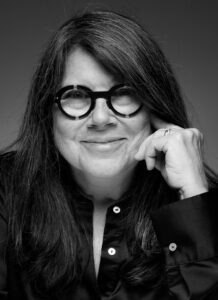
Faculty

Originally from Chile and a former journalist, Claudia Strong is now in her 20th year teaching graphic design and writing to emerging designers, photographers and filmmakers at Syracuse University’s S.I. Newhouse School of Public Communications in New York.
In what has turned out to be a delightfully circuitous and varied communications career, Strong began as a newspaper journalist after earning a Bachelor of Science degree from Northwestern University’s Medill School of Journalism, then moved to the visuals side of the newsroom to help launch the paper’s digital design era before eventually entering the freelance world and, later, academia. While on sabbatical in 2023, she served as a visiting scholar with the VII Foundation at its academy in Sarajevo, Bosnia and Herzegovina, where she developed a new facet to her career, curation and exhibition design. Since then, she has curated and designed numerous national and international exhibitions to present and promote meaningful photographic storytelling, including at the EU Parliament in Strasbourg, France, as well as in festivals and galleries in China, Croatia, Serbia, Lithuania and the United States. She now also serves as curator of communications, design and exhibitions for The Alexia, a center at the Newhouse School that supports documentary visual storytellers around the world.
Fluent in Spanish and adventure, she embraces all sorts of exciting exploits with her husband and their trusty tent.
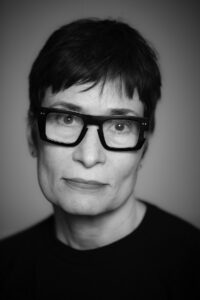
Two-time Pulitzer Prize-winning photographer and picture editor Paula Nelson is a 30-year-career visual journalist, serving as photographer, picture editor, manager, leader and educator.
Nelson began her career as a staff photographer at The Dallas Morning News, where she covered a variety of assignments, from breaking news to sports to features and award-winning studio work. She also traveled to India, Thailand, Mexico, Russia, Latvia, Estonia, Cuba, around the country and around the state of Texas documenting long-term projects. Nelson and a small team of colleagues were awarded the 1994 Pulitzer Prize for Violence Against Women: A Question of Human Rights. After 13 years, she became a picture editor, shepherding an award-winning photography staff and earning her recognition as one of the top picture editors in the country.
After leaving Dallas, Nelson became the Page One picture editor at The Boston Globe in 2002, editing tens of thousands of images to illustrate daily special sections during the Iraq and Afghanistan Wars. She also worked to define the visual philosophy of both print and online publications, and to improve the quality of visuals produced by the staff. Nelson quickly became director of photography, managing an award-winning staff of 31 still and video visual producers and eventually became The Globe’s first and only assistant managing editor for photography, the highest rank in the newsroom for a visual professional. In 2014, The Globe was awarded the Pulitzer Prize for its multimedia coverage of the marathon bombing, which included visuals produced under Nelson’s leadership.
Following a sabbatical, Nelson became a fellow at the S.I. Newhouse School of Visual Communications at Syracuse University and earned a Master of Science in Multimedia, Photography and Design in May of 2021. Her three-part master’s project includes a book she edited and designed, Analog: Collected Family Photographs; a 17-minute audio story, A Box of Photographs, the stories behind family photographs that can be heard on PRX; and a website: https://www.paulafnelson.com/.
With her extensive professional experience in storytelling and visuals and travel to 51 countries, as a professor of practice in the Visual Communications department at Newhouse, Nelson teaches visual storytelling, journalism, photography skills, and picture editing and sequencing for multiple outcomes.